
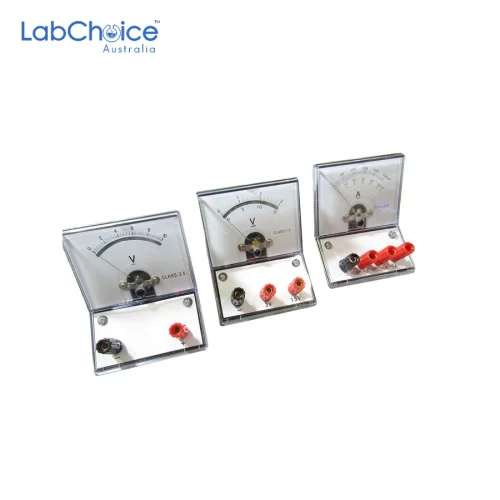
Centre Zero Student Meter for DC Current
From AUD 43.90 (Ex GST)
Centre Zero Student Volt Meter, Dual Range Galvanometer Type
AUD 43.90 (Ex GST)
Centre Zero Student Volt Meters, DC Polarity Teaching Type
From AUD 43.90 (Ex GST)
Dual Range Analog DC Voltmeter for Student Experiments
From AUD 43.90 (Ex GST)
Dual Range Centre Zero Student Microammeter
From AUD 43.90 (Ex GST)
Dual Range Student Ammeters, AC and DC Current Type
From AUD 43.90 (Ex GST)
Single Range Student Meters For Circuit
From AUD 43.90 (Ex GST)
Single Range Student Volt Meters, AC and DC Voltage
From AUD 43.90 (Ex GST)
Student Triple Range DC Ammeter, Classroom Current Meter
From AUD 43.90 (Ex GST)
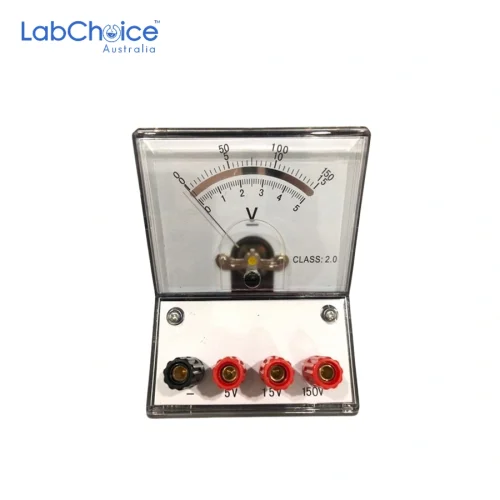
Student Triple Range DC Voltmeter, Physics Lab Voltage Teaching Meter
From AUD 43.90 (Ex GST)
Analogue Electrical Meters are classroom-focused measuring instruments designed for teaching voltage, current, polarity, and deflection principles in physics and electrical science education. These meters typically include centre-zero, single-range, dual-range, and triple-range configurations, allowing students to observe current direction, polarity reversal, and magnitude changes in real time. The analogue needle movement provides a clear visual representation of electrical behaviour, making them suitable for demonstration-based learning and hands-on circuit experiments.
These meters are widely used in schools, universities, and training laboratories for teaching DC current, AC/DC measurement concepts, voltage behaviour, and basic circuit analysis. Centre-zero meters are particularly useful for demonstrating polarity and current direction, while multi-range meters allow students to work across different measurement scales within the same experiment. The robust classroom design supports repeated use in teaching environments where durability, visibility, and ease of connection are important.
For quality and compliance reference, IEC 60051 is a key international standard covering direct acting indicating analogue electrical measuring instruments, including performance, accuracy classes, and construction requirements. This standard is relevant for analogue ammeters, voltmeters, and related educational meters. IEC 61010 is also widely recognised for safety requirements of electrical equipment for measurement, control, and laboratory use, supporting safe operation in laboratory and classroom environments. These standards should be referenced where supported by the manufacturer’s technical documentation and compliance data.
For LabChoice Australia customers, Analogue Electrical Meters provide a practical and effective solution for physics education, enabling clear demonstration of electrical principles through direct visual feedback. Their simplicity, reliability, and teaching-focused design make them suitable for structured classroom experiments, laboratory demonstrations, and foundational electrical training.