
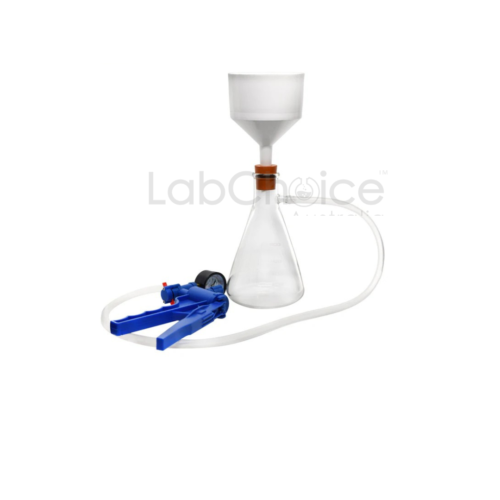
Buchner Filtration Flask Kit, Vacuum Filter Flask Set, BORO 3.3
From AUD 134.90 (Ex GST)
Buchner Filtration Flask Kit, Vacuum Filter Flask Set, BORO 3.3 is designed for separating solid material from a liquid using vacuum-assisted filtration. The kit brings together the main components required for a standard Büchner filtration setup, including a Büchner funnel, side-arm filter flask, sealing connection, vacuum tubing and a compatible vacuum source, depending on the selected configuration.
During filtration, suitable filter paper is placed flat inside the Büchner funnel and lightly wetted with the working solvent to help form a seal. The prepared mixture is then poured into the funnel while suction is applied through the side arm of the flask. The pressure difference draws the liquid through the filter paper and into the flask, leaving the collected solid on the filter surface. Vacuum filtration is commonly used when the solid product needs to be recovered after precipitation, crystallisation or recrystallisation.
The Büchner funnel should be fitted securely into the flask using the supplied or compatible rubber adapter. A close seal between the funnel and flask is important because air leakage can reduce suction and slow the filtration process. Filter paper should cover the perforated area without folding up the sides of the funnel, and its retention grade should be selected according to the particle size and required filtration rate.
The side-arm flask collects the filtrate and connects the apparatus to the vacuum tubing. Laboratory filter flasks are made with heavier walls than ordinary conical flasks to provide additional mechanical strength during vacuum filtration. ISO 6556 specifies requirements for conical and cylindrical laboratory filter flasks, including their general construction and vacuum connection.
The vacuum filter flask is described as BORO 3.3 borosilicate glass, a material valued for its low thermal expansion, chemical durability and clear visibility. The transparent flask makes it easy to monitor the filtrate level and identify foaming, colour changes or liquid carryover during use. ISO 3585 defines the properties of borosilicate glass 3.3, while ASTM E438 covers glasses commonly used in laboratory apparatus, including low-expansion borosilicate glass.
The flask should be clamped securely before suction is applied because the combined funnel and flask assembly can become top-heavy. Thick-walled vacuum tubing should be used where required because ordinary flexible tubing may collapse under reduced pressure. Where a water aspirator or vacuum pump could draw liquid back towards the sample, a suitable vacuum trap should be installed between the filtration flask and the vacuum source. MIT laboratory guidance also recommends securing the flask, checking the adapter seal and using a trap where backflow could contaminate the filtrate.
Before each use, the flask and funnel should be inspected for cracks, chips, scratches or damage around the side arm and sealing surfaces. Glassware with visible damage should not be placed under vacuum. Users should also confirm the flask capacity, funnel diameter, filter paper size, tubing connection, vacuum level and chemical compatibility for the intended sample. The set must not be used as a positive-pressure vessel.
For LabChoice Australia customers, the Buchner Filtration Flask Kit offers a convenient setup for schools, universities, research laboratories, chemistry teaching facilities and quality control laboratories carrying out compatible precipitate recovery, crystal collection, sample clarification and routine solid-liquid separation.