
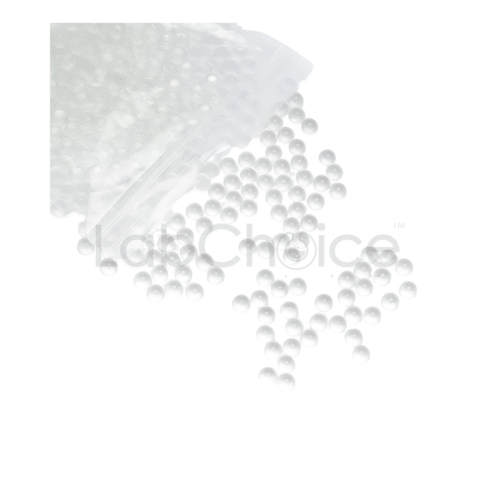
Laboratory Glass Beads, 500g Pack for Sterilisation & Heating
From AUD 21.50 (Ex GST)
Laboratory Glass Beads, supplied in a 500 g pack, are intended for use as a heat-transfer medium in compatible glass bead sterilisers and laboratory heating equipment. When heated inside a purpose-designed chamber, the beads surround the inserted section of a small instrument and transfer dry heat across its surface. This makes them suitable for compatible laboratory tools that can safely withstand the equipment’s operating temperature.
Glass bead sterilisers are commonly used with small, solid metal or glass implements. The instrument is inserted into the heated bead chamber for the time specified by the equipment manufacturer. Only the working end should be placed into the beads unless the instrument and steriliser instructions state otherwise. Thermo Fisher describes dry glass bead sterilisers as equipment for processing small solid metal and glass implements.
The 500 g pack can be used to fill or replace the bead medium in compatible equipment, subject to the chamber capacity and bead-size requirements. Users should confirm the bead diameter, chamber dimensions, operating temperature and equipment compatibility before use. Beads that are contaminated, damaged or unsuitable for the steriliser chamber may affect heat transfer and should be replaced according to the equipment manufacturer’s instructions.
Glass beads should not automatically be described as conventional boiling chips. Controlled boiling aids generally depend on porous surfaces that provide nucleation sites and help reduce sudden bumping in heated liquids. The suitability of these glass beads for direct addition to liquids should therefore be confirmed by the manufacturer before they are promoted for boiling, reflux or distillation procedures.
Sterilisation cannot be confirmed from the use of heated glass beads alone. The result depends on the steriliser temperature, exposure time, instrument material, insertion depth, initial contamination and validation procedure. ISO 20857 provides requirements for the development, validation and routine control of dry-heat sterilisation processes for medical devices. ISO 11138-4 covers biological indicators used to assess dry-heat sterilisation processes. These standards provide useful process context but do not confirm that these glass beads or any particular bead steriliser comply with their requirements.
The beads and steriliser chamber should be allowed to cool before cleaning, replacement or handling. Heat-resistant tools and suitable personal protective equipment should be used where required. Users should not insert plastic, coated, hollow, heat-sensitive or combustible items unless the equipment manufacturer confirms that they are suitable for glass bead sterilisation.
For LabChoice Australia customers, Laboratory Glass Beads provide a practical replacement or filling medium for compatible glass bead sterilisers and laboratory heating systems. They are suitable for universities, research facilities, microbiology teaching laboratories and other controlled laboratory environments where equipment compatibility and validated dry-heat procedures have been established.