
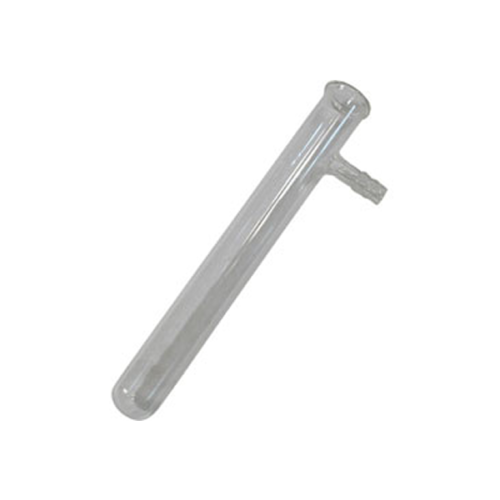
Borosilicate Side Arm Test Tubes, Laboratory Filtration Range
From AUD 4.90 (Ex GST)
Borosilicate Side Arm Test Tubes are designed for laboratory procedures where a sample or reaction is held in the main tube while gas or suction is directed through the lateral outlet. The side arm can be connected to suitably sized laboratory tubing, allowing the tube to form part of gas-generation, gas-transfer and small-scale filtration assemblies.
During gas preparation experiments, reagents are placed in the main tube and the gas produced by the reaction leaves through the side arm. The outlet may be connected to a gas syringe, pneumatic trough, collection vessel or other suitable receiving apparatus. A University of Massachusetts laboratory procedure uses a side-arm test tube during hydrogen generation, demonstrating how this design can direct evolved gas from the reaction vessel into the next part of the setup.
The same side-arm arrangement can also support microscale suction filtration when the tube is used with a suitable funnel, adapter and vacuum connection. In this type of setup, suction applied through the side arm draws liquid through the filter medium and into the tube. MIT laboratory filtration guidance explains the use of vacuum tubing, side-arm glassware and a water trap in suction filtration assemblies.
The borosilicate glass construction provides clear observation of the sample, liquid level, precipitate and reaction behaviour. Borosilicate glass is commonly selected for laboratory apparatus because of its thermal and chemical properties, although the exact glass grade, temperature limit and chemical compatibility of these tubes should be confirmed from the manufacturer’s specifications.
ISO 4142 specifies test tubes suitable for general laboratory use and includes test tubes manufactured from borosilicate glass. ISO 4803 covers borosilicate 3.3 glass tubing used in laboratory apparatus and is relevant only where the manufacturer confirms that these side-arm tubes are produced from BORO 3.3 tubing. ASTM E438 provides a broader specification for glass types used in laboratory apparatus.
Before use, each tube should be inspected for cracks, chips, blocked outlets and damage around the side arm. The tubing should fit securely without placing excessive force on the glass outlet. When suction is applied, the tube and connected apparatus should be clamped securely, and a suitable trap should be included where required to protect the sample and vacuum source.
Side Arm Test Tubes should not be treated as pressure vessels. Gas-producing systems must remain safely vented through the intended outlet, and the side arm must not become blocked. Vacuum use should also be limited to procedures and operating conditions confirmed as suitable for the tube, tubing and complete assembly.
For LabChoice Australia customers, Borosilicate Side Arm Test Tubes provide a practical option for schools, universities, research laboratories and chemistry teaching facilities carrying out gas preparation, gas transfer, reaction-rate studies and compatible microscale filtration procedures.