
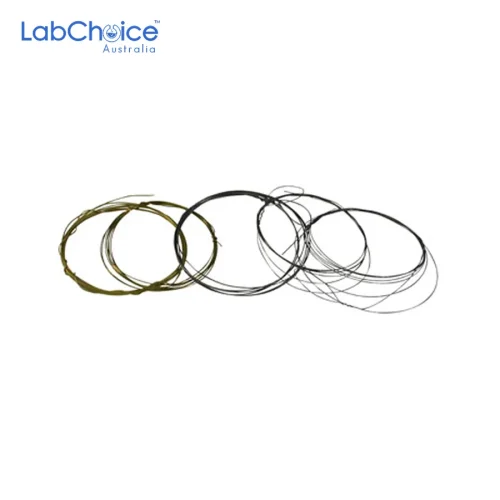
Sonometer Spare Set of Wires
- Spare wire set for compatible sonometer apparatus
- Suitable for sound, vibration and Mersenne’s law demonstrations
- Includes brass wire
- Includes iron wire
- Includes badminton racket wire
- Supports comparison of different string or wire materials
- Useful for frequency, pitch and vibrating string experiments
- Suitable for school physics and teaching laboratory workflows
- Confirm compatibility with the sonometer before ordering
- Use under appropriate laboratory or educational supervision
AUD 18.90 (Ex GST)
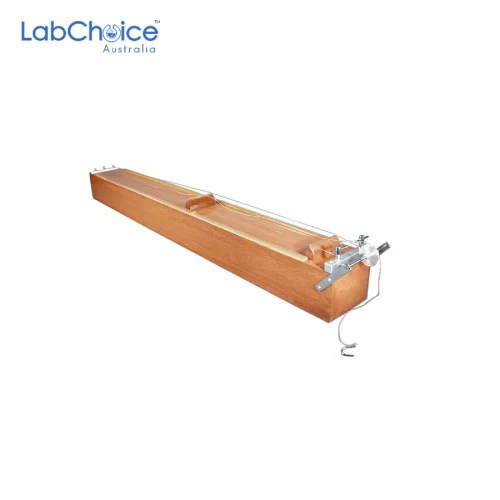
Wooden Hollow Sonometer, 1 m, Mersenne’s Law
- Wooden hollow sonometer for sound and vibration demonstrations
- Length listed as 1 m
- Designed for demonstrating Mersenne’s law
- Shows the relationship between string frequency, tension, length and mass per unit length
- Suitable for plucked string sound experiments
- Useful for teaching pitch, frequency, resonance and wave behaviour
- Hollow wooden body supports classroom sound demonstration work
- Suitable for physics laboratories and educational settings
- Spare set of wires available separately under LC-80-PA1369-01
- Use under appropriate laboratory or educational supervision
AUD 120.90 (Ex GST)
Sonometers are classroom physics apparatus used to demonstrate frequency, resonance, standing waves, and the behaviour of vibrating wires under tension. This category includes sonometers and spare wire sets for frequency demonstration activities, making it suitable for schools, physics laboratories, and science teaching environments where students need a clear hands-on way to study sound and wave behaviour.
In a typical sonometer experiment, a stretched wire is used to show how sound frequency changes when wire length, tension, or wire type is changed. This helps students connect practical observations with key physics concepts such as wavelength, pitch, resonance, harmonics, and standing waves. OpenStax explains that standing waves form when waves reflect and interfere under fixed boundary conditions, and that tension affects wave speed in a stretched string or wire.
Spare wire sets are useful for repeated classroom experiments, replacement needs, and demonstrations comparing different wire conditions. They help teachers keep sonometer equipment ready for practical lessons where wires may need to be changed, replaced, or selected for different demonstration setups. This makes the range practical for physics departments running regular sound, frequency, and wave experiments.
Sonometers are especially valuable in teaching because they let students see and hear the relationship between mechanical vibration and sound. NIST defines frequency as the number of cycles per second, measured in hertz, which is the same measurement language used when teaching sound, pitch, and vibration experiments.
For LabChoice Australia customers, Sonometers provide a practical classroom frequency demonstration range for schools, universities, and teaching laboratories that need equipment for sound waves, standing wave behaviour, vibrating wire experiments, and hands-on acoustics learning.