
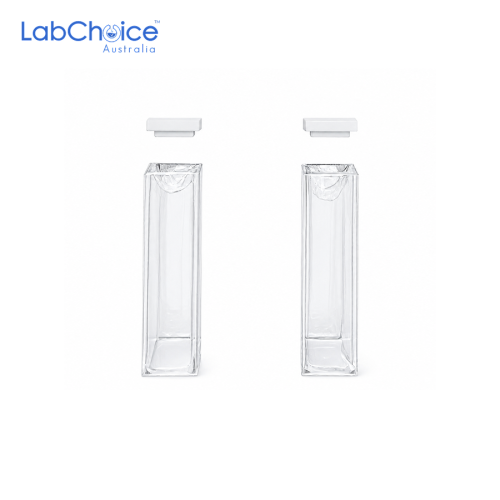
Glass Cuvette with Lid for Visible Spectrophotometry - Pack of 2 Pcs
- Glass cuvette with lid for routine UV-Vis spectrophotometry and visible-range optical testing
- Suitable for compatible spectrophotometers, colorimeters and general laboratory analysis
- Clear glass construction supports reliable absorbance, transmission and concentration measurements
- Lid helps reduce sample evaporation, contamination and accidental spillage during handling
- Ideal for prepared reagents, colourimetric samples, water testing, teaching labs and QC applications
- Suitable for scientific, educational, industrial and quality control laboratories
AUD 44.90 (Ex GST)
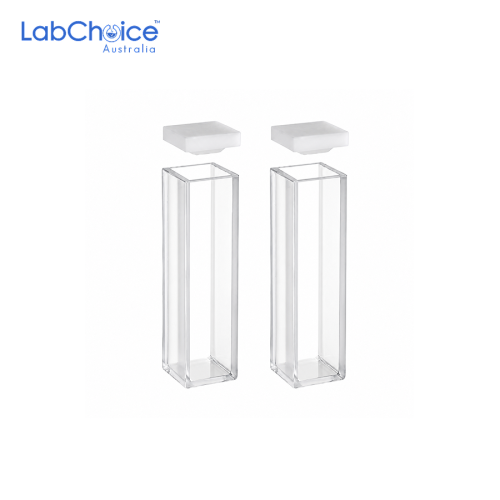
UV-Vis Quartz Cuvette with Lid for Spectrophotometry - Pack of 2 Pcs
- UV-Vis quartz cuvette with lid for spectrophotometry applications
- Suitable for absorbance, transmittance and concentration measurements
- Optical quartz construction supports UV and visible wavelength analysis
- 10 mm path length for standard spectrophotometer testing
- Lid helps reduce evaporation, dust exposure and sample contamination
- Ideal for chemical, biological, water, environmental and QC sample testing
- Suitable for research, education, pharmaceutical and laboratory analysis workflows
AUD 119.90 (Ex GST)
Cuvettes & Spectrophotometry Cells are optical sample containers designed to hold liquid samples within the light path of a compatible spectrophotometer. This category includes the Glass Cuvette with Lid for Visible Spectrophotometry and the UV-Vis Quartz Cuvette with Lid for Spectrophotometry, with both products supplied in packs of two.
During spectrophotometric analysis, light passes through the transparent optical faces of the cuvette and the liquid sample inside. The instrument measures the amount of light transmitted or absorbed at a selected wavelength, supporting concentration measurements, absorbance testing, sample comparison, and other compatible analytical procedures. Cuvette material, optical path length, sample volume, cleanliness, and positioning can influence measurement quality.
Glass cuvettes are intended for compatible visible spectrophotometry procedures. Quartz cuvettes are selected for UV-Vis spectrophotometry because suitable quartz materials can transmit ultraviolet and visible wavelengths more effectively than standard optical glass. The exact wavelength range, path length, internal volume, dimensional tolerance, and solvent compatibility should be confirmed from the product specifications before use. Hellma Analytics provides technical information explaining the different optical transmission characteristics of glass and quartz cuvette materials.
The supplied lids help cover the sample chamber during compatible testing, storage, or handling procedures. Users should ensure the cuvette is filled correctly and free from bubbles, suspended particles, fingerprints, residues, scratches, and external moisture because these conditions may affect the light path and measurement consistency. Cuvettes should be handled by the non-optical surfaces wherever practical.
Correct cuvette selection should be based on the instrument cell holder, required wavelength range, optical path length, sample volume, sample chemistry, and analytical method. Glass and quartz cuvettes that appear dimensionally similar may not provide the same spectral transmission or chemical compatibility. Users should also confirm whether the cuvette is suitable for aqueous solutions, organic solvents, acids, alkalis, or other sample types before use.
ISO 20473 defines spectral bands used in optics and photonics, including ultraviolet and visible regions. ISO/TS 17466 provides an example of UV-Vis absorption spectroscopy used for analytical characterisation, while ISO 10566 describes a spectrometric water-analysis method using cells with defined optical path lengths. These ISO references support the terminology and analytical use of spectrophotometric cells, but they should not be presented as construction or product-compliance claims for these cuvettes unless confirmed by manufacturer documentation.
For LabChoice Australia customers, Cuvettes & Spectrophotometry Cells provide practical glass and quartz sample-container options for universities, schools, research laboratories, quality control facilities, environmental testing laboratories, chemistry laboratories, and routine visible or UV-Vis spectrophotometric workflows.