
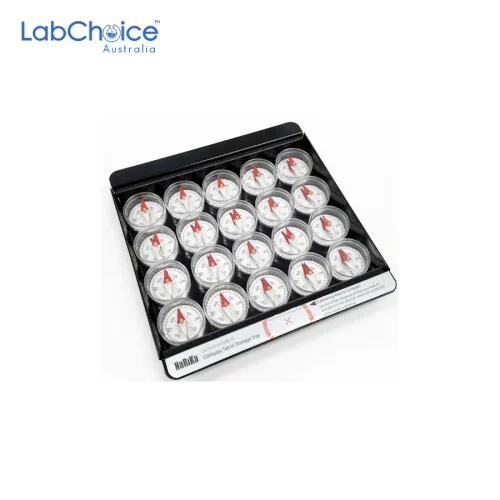
Compass Set of 20 in Storage Container with Calibration Strip
- Classroom compass set for science and geography education
- Supplied as 20 compasses in a storage container
- Includes calibration strip for compass orientation support
- Compass diameter listed as 40 mm
- Storage tray size listed as 210 × 215 × 25 mm
- Helps provide consistent compass results across a class
- Useful for magnetism, direction and navigation activities
- Calibration strip magnetises compasses into the correct orientation
- Spare compasses are available separately
- Suitable for school, university and teaching laboratory use
- Keep away from strong magnets and magnetic interference when reading
- Use under appropriate laboratory or educational supervision
AUD 359.90 (Ex GST)
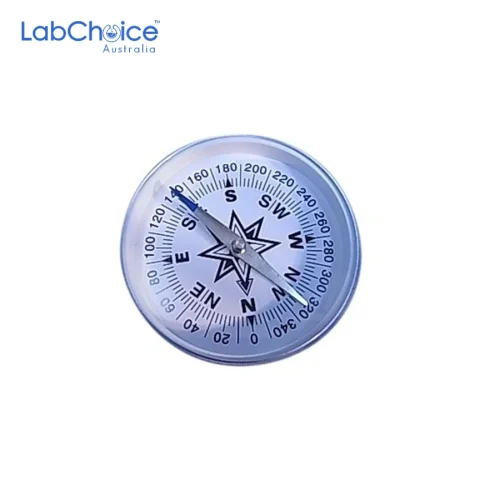
Large Demonstration Compass, 77 mm Diameter
- Large demonstration compass for science education
- Magnetic compass designed for classroom visibility
- Diameter listed as 77 mm
- Useful for teacher-led demonstrations
- Supports lessons on magnetism and Earth’s magnetic field
- Practical tool for showing compass direction and needle movement
- Suitable for physics, geography, field science and STEM teaching
- Larger size helps students observe compass behaviour more clearly
- Suitable for school, university and teaching laboratory use
- Keep away from strong magnets and magnetic interference when reading
- Use under appropriate laboratory or educational supervision
AUD 4.90 (Ex GST)
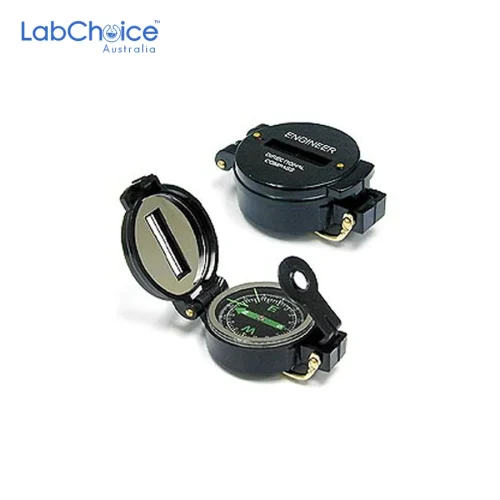
Liquid Filled Orienteering Compass with Lens
- Magnetic orienteering compass for educational and field use
- Liquid filled design supports smoother needle movement
- Includes lens for easier reading and observation
- Useful for direction finding and basic navigation activities
- Suitable for geography, physics, field science and outdoor education
- Supports lessons on magnetism, Earth’s magnetic field and compass use
- Practical teaching tool for school and university activities
- Compact compass format for classroom and field demonstrations
- Confirm scale, size and graduation details before ordering
- Keep away from strong magnets and magnetic interference
- Use under appropriate laboratory or educational supervision
AUD 13.90 (Ex GST)
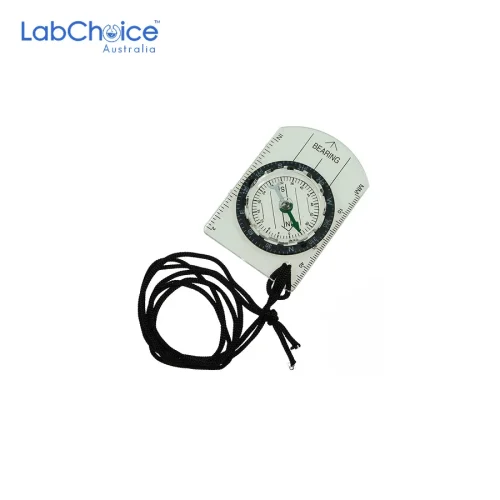
Magnetic Map Orienteering Compasses, Large and Small
- Magnetic map orienteering compasses for education and fieldwork
- Suitable for direction finding, map work and basic navigation activities
- Useful for geography, outdoor education, science and STEM lessons
- Large compass size listed as 140 × 60 × 17 mm
- Large compass is supplied in blister pack
- Small compass size listed as 70 × 48 × 9 mm
- Small compass is supplied in a plain white box
- Small compass packing listed as 50 per inner carton
- Small compass packing listed as 500 per outer carton
- Keep away from strong magnets and magnetic interference when reading
- Use under appropriate laboratory or educational supervision
From AUD 8.90 (Ex GST)
This product has multiple variants. The options may be chosen on the product page
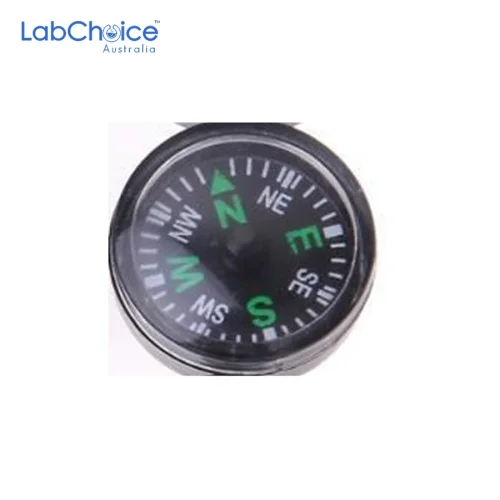
Magnetic Plotting Compass, 18 mm Diameter - Each
- Magnetic plotting compass for physics and classroom use
- All plastic compass construction
- Diameter listed as 18 mm
- Liquid filled design supports smoother movement
- No needle type design
- Sold as each
- Useful for magnetic field plotting activities
- Suitable for mapping field direction around magnets
- Practical tool for student magnetism experiments
- Suitable for school, university and teaching laboratory use
- Keep away from strong magnets when not in active use
- Use under appropriate laboratory or educational supervision
AUD 2.50 (Ex GST)
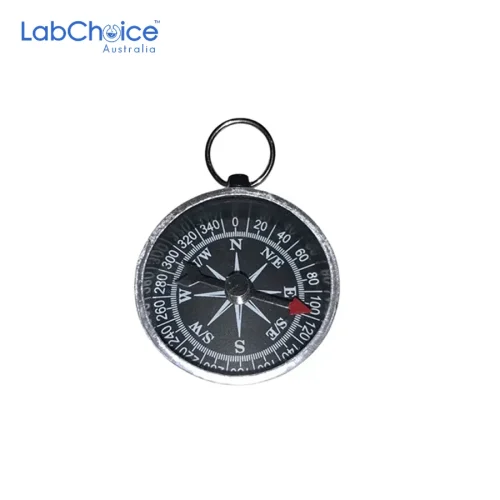
Student Magnetic Compass, 35 mm Diameter
- General purpose magnetic compass for student use
- Suitable for science experiments and classroom demonstrations
- Diameter listed as 35 mm
- Weight listed as 7.8 g
- Useful for magnetism, direction and navigation activities
- Supports lessons on Earth’s magnetic field and compass behaviour
- Practical size for class sets and student handling
- Suitable for school, university and teaching laboratory use
- Keep away from strong magnets and magnetic interference when reading
- Use under appropriate laboratory or educational supervision
AUD 4.50 (Ex GST)
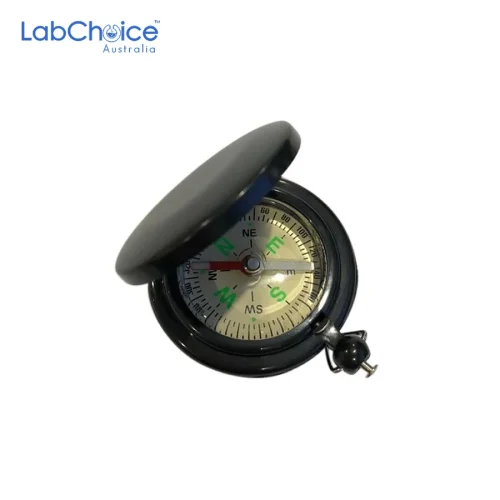
Student Magnetic Compass, 35 mm Diameter with Lid
- General purpose student compass for science education
- Magnetic compass for classroom and field activities
- Diameter listed as 35 mm
- Supplied with lid for protection during storage
- Useful for direction finding and basic navigation lessons
- Supports magnetism and Earth’s magnetic field demonstrations
- Practical size for student handling in class sets
- Suitable for school, university and teaching laboratory use
- Keep away from strong magnets and magnetic interference when reading
- Use under appropriate laboratory or educational supervision
AUD 6.50 (Ex GST)
Compass & Navigation Tools includes navigation compasses, plotting compasses, and class sets used for teaching direction, bearings, magnetic fields, and basic map navigation. These products are well suited to school science, geography, outdoor education, physics demonstrations, and classroom group activities where students need a simple hands-on way to understand direction finding.
Navigation compasses help students identify cardinal directions and practise basic bearing work. Plotting compasses are useful in physics lessons for showing how a compass needle responds to a magnetic field, including field direction around magnets and simple electromagnetism demonstrations. OpenStax explains that the direction of a magnetic field is the direction in which the north end of a compass needle points, making compasses a practical tool for visualising magnetic field behaviour.
Class sets are useful for schools because multiple students can work at the same time during fieldwork, map reading, or magnetic field experiments. Teachers can use these tools to demonstrate north, south, east and west, angle-based bearings, compass orientation, magnetic field lines, and the difference between classroom diagrams and real instrument readings.
For navigation lessons, users should understand that a magnetic compass points according to the local horizontal component of Earth’s magnetic field, not always exactly to true north. NOAA notes that magnetic declination is used to correct magnetic bearings to true bearings, and USGS explains that declination varies with location and time. These references are useful for teaching navigation accuracy, but should not be used as product-specific accuracy or certification claims unless supported by manufacturer documentation.
For LabChoice Australia customers, Compass & Navigation Tools provides a practical classroom range for schools, geography departments, physics laboratories, and outdoor education programs that need navigation compasses, plotting compasses, and class sets for direction work, bearings, magnetic field mapping, and hands-on science learning.