Fluid Mechanics Demos Using Reliable Labware for Aussie Labs
Fluid mechanics sounds very technical, but at its heart it is simply about how liquids and gases move. When we pour, pump, heat, or cool a liquid in a lab, we are working with fluid mechanics. Clear, hands-on demonstrations help students and staff see what is really happening, instead of only reading formulas on a page.
Good demonstrations need good labware. If a cylinder is not accurate, a joint leaks, or a tube clouds over, the lesson quickly loses impact. In Australian schools, TAFE settings, universities, and industry labs, reliable glassware, plasticware, and equipment make the difference between a neat trick and real understanding.
Why Fluid Mechanics Depends on Reliable Labware
Across chemistry, biology, and engineering, we meet the same basic questions: how fast does a liquid flow, how much pressure is in a system, and how does temperature change that flow? These questions show up in real work such as distillation, chromatography, flow reactors, microfluidics, and quality control testing.
To show these ideas clearly, the labware must behave in a predictable way. Poor quality items can cause:
- Leaks around joints and tubing
- Cracks under heat or vacuum
- Wrong volumes from bad graduation marks
- Unsafe breakage in busy teaching labs
When that happens, the lesson is no longer about fluid mechanics; it is about mopping up a spill. This is why general labware for chemistry and fluid mechanics demonstrations needs to be reliable, safe, and consistent, lesson after lesson.
Choosing the Right Labware for Fluid Mechanics
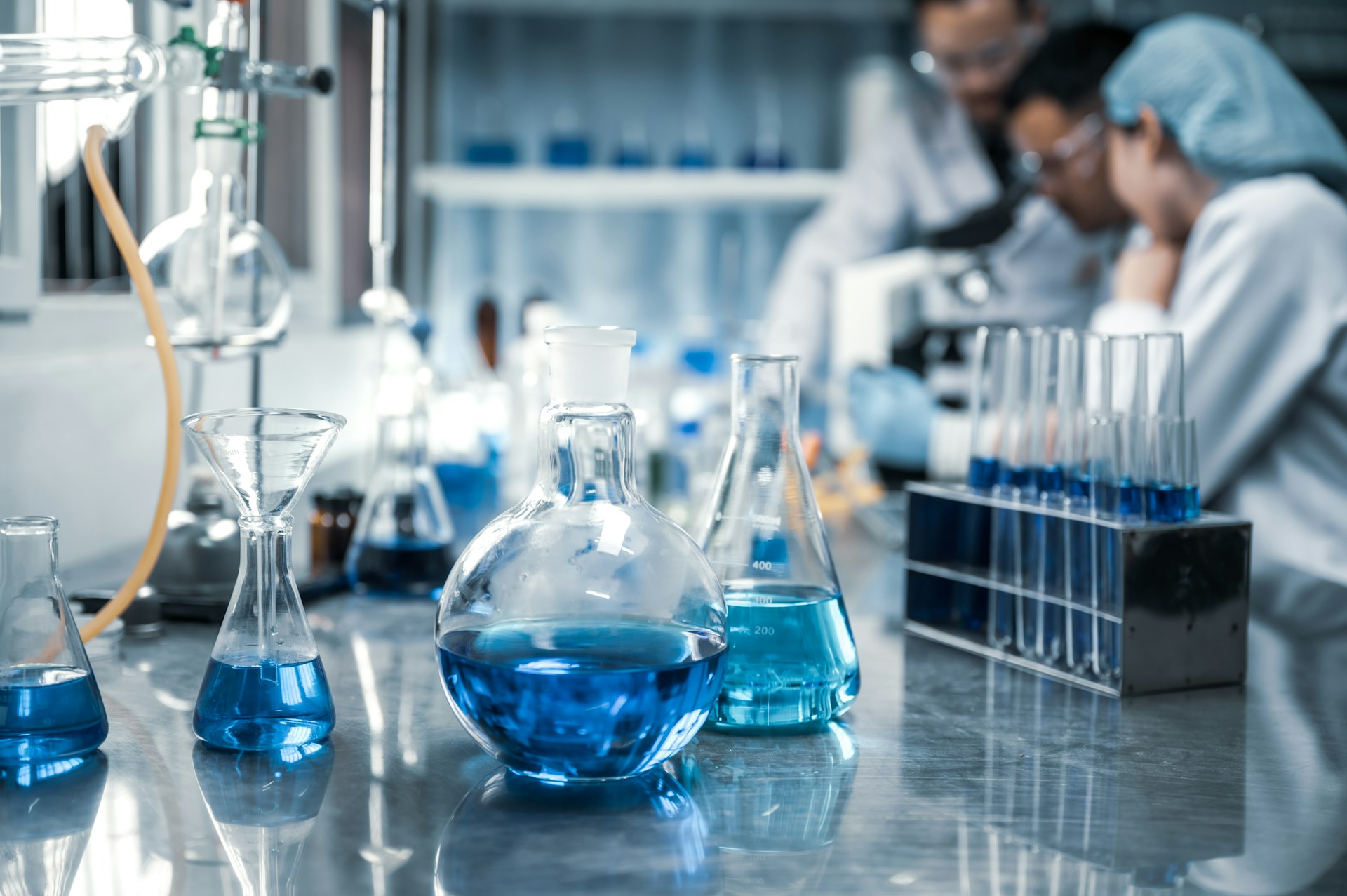
Borosilicate BORO 3.3 glass is the workhorse for many fluid demonstrations. It has low thermal expansion, good chemical resistance, and stays clear over time, so students can actually see what the fluid is doing. It also copes well with heating and cooling, which is helpful when you are changing temperature during an experiment.
Common BORO 3.3 items for fluid work include:
- Measuring cylinders and volumetric flasks
- Burettes and pipettes for accurate volume control
- Glass tubing, manometers, and flow tubes
- Condensers and distillation assemblies
Polylab plasticware is handy when glass is not required. It is lighter, more impact resistant, and usually more forgiving in busy classrooms. Polylab beakers, funnels, wash bottles, measuring cylinders, and reagent bottles are often a good choice for:
- Room temperature flow trials
- Basic mixing and transfer work
- High-throughput teaching where breakages are common
A simple rule is: use BORO 3.3 for heat, aggressive reagents, or where clarity and tight tolerances matter, and Polylab plasticware for safer handling and everyday general labware for chemistry and fluid dynamics practicals.
Core equipment also shapes your fluid setups. Many labs rely on:
- Peristaltic or diaphragm pumps for controlled flow
- Vacuum pumps for filtration and pressure work
- Magnetic stirrers and hotplates for mixing and heating
- Support stands, clamps, and pressure gauges to keep everything stable and measurable
Compatibility with standard joint sizes and standard taper fittings on BORO 3.3 assemblies helps you build systems that are easy to adjust or expand.
Classic Fluid Mechanics Demonstrations with Glassware
One of the simplest but most effective lessons is comparing laminar and turbulent flow in clear glass tubing. By running water through BORO 3.3 tubes and injecting a thin stream of dye, students can see:
- Smooth, straight dye lines at low flow (laminar)
- Swirling, mixed patterns at higher flow (turbulent)
Because the glass is clear and the internal diameter is consistent, it becomes easier to link what they see to ideas like Reynolds number and to real systems such as chromatography columns or process lines.
Bernoulli’s principle and Venturi effects are another favourite. A glass Venturi tube with side arms connected to manometers and coloured manometer fluid lets students see how pressure drops when velocity increases. To get a clean result, you need:
- Precise bore dimensions in the Venturi section
- Leak-free joints at the glass connectors
- Stable manometer tubes with easy-to-read levels
This connects directly to gas and liquid flow in distillation columns, fume extraction, and aeration lines.
Hydrostatics and pressure columns are simple to set up using BORO 3.3 measuring cylinders, manometer tubes, and sealed bottles. By changing the height of a water column or using liquids of different density, you can show how pressure grows with depth. These same ideas apply to density gradients, liquid-liquid separations, and packing height in column chromatography, all using general labware for chemistry hydrostatics experiments.
High-Temperature Fluid Demonstrations and Heat Transfer
Distillation is a great way to bring fluid mechanics and heat transfer together. A basic setup uses BORO 3.3 round-bottom flasks, a condenser, adapters, and receivers. As the mixture boils, students see:
- Vapour rising and condensing on cooler glass
- Condensate flowing through the condenser
- Coolant flowing in the outer jacket, often tinted for visibility
BORO 3.3 glass handles the temperature changes and works well with heating mantles or hotplates, reducing stress cracks and helping joints stay tight.
Viscosity lessons are also very visual. By timing how long different liquids take to flow through glass capillary tubes or out of graduated pipettes, students quickly feel the difference between water, glycerol, and oils. This is easier when:
- Bore sizes are accurate and repeatable
- Graduations are sharp and easy to read
- Volumes match the stated tolerance
These same ideas carry across to lubricant checks, formulation work, and pharmaceutical testing.
For convection and general heat transfer, tall BORO 3.3 beakers or cylinders on a hotplate, with a bit of coloured dye, show warm fluid rising and cooler fluid sinking. Glass clarity makes these currents clear, and the glass works safely with temperature probes and stirring.
Fluid Mechanics in Biology and Life Sciences
Fluid mechanics is not only for chemistry and physics labs. In microbiology and cell culture, flow, mixing, and shear all affect growth, biofilm formation, and cell health. Polylab flasks and bottles, along with BORO 3.3 glassware, are commonly used on shakers and in feed lines to move media, buffers, and inoculum in a controlled way.
Careful liquid handling is also at the heart of pipetting and serial dilutions. Using accurate cylinders, beakers, and pipettes, along with low-retention plasticware, helps keep dilution series consistent. This supports:
- Gradient setups that mimic microfluidic flow patterns
- Media and buffer preparation
- Sample handling before analytical testing
In microbiology labs, safe liquid transfer matters as much as numbers. Polylab wash bottles, funnels, and bottles designed to reduce splashing help limit aerosols and keep benches cleaner. Flow paths, drainage angles, and secure caps all support better aseptic technique where fluid handling and sterility intersect.
Designing Demonstrations for Australian Classrooms and Teaching Labs
Classrooms and undergraduate labs in Australia need gear that stands up to regular use. BORO 3.3 glassware is strong for glass, but Polylab plasticware often copes better with knocks and drops. Many teachers find a mix works best, for example:
- Plastic beakers for general mixing and waste
- BORO 3.3 cylinders for accurate measuring
- Plastic funnels and wash bottles for safer transfer
Wide bases, clear markings, and strong labelling make it easier for students to work on their own without losing accuracy.
For formal assessments, many programs expect volumetric glassware that aligns with common ISO or ASTM tolerances. Standards-compliant cylinders, volumetric flasks, and burettes support fair comparisons between classes and campuses. Traceability, batch labels, and documentation also help technical staff maintain consistency across teaching spaces.
Schools and universities often build small “bundles” of gear that can run multiple fluid mechanics demonstrations, for example, Bernoulli setups, hydrostatic columns, viscosity tubes, and convection towers, all from the same pool of general labware for chemistry and physics demonstrations. This keeps prep time under control while still giving students a broad, hands-on feel for fluid behaviour.
Equip Your Lab With Reliable Chemistry Essentials
If you are looking to standardise your workflows and reduce downtime, we can help you choose the right general labware for chemistry to suit your applications and budget. At LabChoice Australia, we focus on practical, dependable solutions that support accurate results in real lab conditions. Whether you are setting up a new space or upgrading existing equipment, our team is ready to discuss options that fit your needs. If you would like tailored advice or a product recommendation, please contact us.