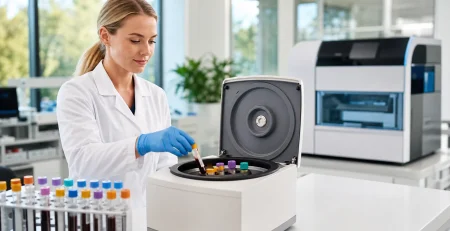
A mini centrifuge can make everyday sample preparation quicker and more consistent. We recommend it for routine, low-volume jobs such as bringing droplets down from tube walls, collecting condensate after incubation and settling mixtures after vortexing.
Used within its limits, this compact laboratory tool reduces repeat handling and helps keep preparation steps tidy. The right choice depends on your sample volumes, tube types, required force and the procedures your team follows.
Faster Sample Preparation Starts with the Right Mini Centrifuge
For frequent small-volume handling, a mini centrifuge is a practical bench companion. It can quickly spin liquid from caps and tube walls to the bottom of a tube, which helps keep the full sample together before the next step.
We see mini centrifuges used across research, education, testing and industrial laboratories where staff need a fast spin-down without setting up a larger unit. Still, a mini centrifuge is made for rapid routine tasks, not every type of separation.
Before choosing a laboratory centrifuge machine, we suggest matching its speed, relative centrifugal force (RCF), rotor format and capacity to the work you actually perform. This supports more consistent preparation and helps protect samples from unnecessary repeat handling.
Match Mini Centrifuge Tasks to Everyday Samples
Mini centrifuges are especially useful when your method calls for a short spin rather than a demanding separation. Common jobs include collecting PCR mixtures, settling droplets after mixing and clarifying selected low-volume samples. Some compatible tube systems can also support simple microfiltration steps.
These tasks often involve:
- 0.2 mL PCR tubes and PCR strip tubes
- 0.5 mL microcentrifuge tubes
- 1.5 mL microcentrifuge tubes
- 2 mL microcentrifuge tubes
When comparing equipment, focus on RCF rather than RPM alone. RPM tells you how fast the rotor turns. RCF describes the force applied to the sample, and it changes with the rotor radius. Two units running at similar speeds may not apply the same force.
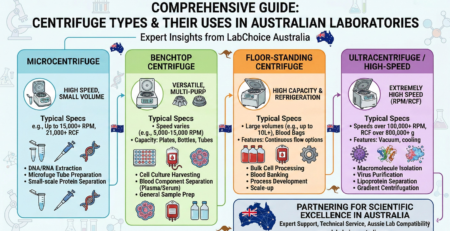
A mini model may be well suited to quick spin-downs and light pelleting. It may not, however, provide the force needed for cell pelleting, precipitation, phase separation or methods that require long runs, controlled temperatures or higher RCF. We recommend checking written methods and kit instructions before replacing a benchtop centrifuge with a compact unit.
Choose Capacity, Rotor Types and Tube Compatibility
Capacity should suit the number of samples you regularly run at once, rather than the largest batch you might occasionally receive. A compact rotor for several microtubes can suit a small work area, while teaching and testing settings may need more flexibility across tube types.
Rotor design deserves close attention. Some mini centrifuges accept standard microcentrifuge tubes, individual PCR tubes or strip tubes. Others need adapters to hold particular formats safely. A combination or interchangeable rotor can be useful when your work changes between tube sizes.
Before selecting a unit, check:
- The maximum tube volume supported by the rotor
- Whether adapters are included and secure during operation
- Lid clearance for the tube cap style you use
- Whether your current consumables fit without modification
A tube may fit into a rotor but still be unsuitable if its cap touches the lid or cannot stay closed while spinning. Poor fit can lead to imbalance, tube damage and uneven results. A laboratory centrifuge machine should work with your existing consumables and sample-preparation practices, rather than requiring improvised adapters or incompatible tubes.
For volatile, infectious, corrosive or otherwise hazardous materials, follow your laboratory risk controls and the equipment instructions. Not every mini centrifuge is suitable for every sample hazard.
Compare RCF, Run Controls and Safety Features
Performance and usability need to be considered together. Available RCF, acceleration behaviour and run duration all affect whether a unit can complete a task reliably. A fixed-speed centrifuge may suit simple spin-downs, while adjustable speed and timer settings can give more control when procedures vary.
Higher RPM does not automatically mean better results. If the rotor design does not provide the RCF required by your method, the sample may not separate as intended. On the other hand, excessive force or run time can affect sensitive samples, create overly compact pellets or make resuspension harder.
We encourage users to look for practical safety features, including a secure lid, lid interlock, stable base, automatic stop function and clear controls. Low vibration and lower noise can also make frequent use more comfortable in a shared work area.
Cleaning matters just as much. Rotor surfaces and accessible components should be easy to inspect and clean according to site procedures. Address spills promptly, and do not continue using equipment with visible residue, cracks, corrosion or worn rotor parts.
Build a Reliable Mini Centrifuge Workflow
Consistent preparation starts before the lid is closed. Check that the rotor, adapters and tubes are clean, dry and approved for the intended speed. Cap samples securely, then place them in balanced positions.
Good routine practice includes:
- Balancing opposing tubes by mass, not just liquid level
- Using similar sample volumes where the procedure allows
- Checking tubes for cracks, weak hinges and loose caps
- Using a compatible balance tube for an odd sample, where permitted
Never run a visibly unbalanced rotor or place unsuitable objects in empty positions to make up a load. If a balance tube is permitted, use compatible liquid and follow the laboratory procedure and equipment instructions.
Once loaded, close the lid securely and select the approved setting or run time. Allow the rotor to stop completely and wait for the lid to unlock before opening. Do not move the unit, try to stop the rotor by hand or open the lid during operation. Unusual noise, vibration or movement means the run should be stopped and the load checked.
Even a compact laboratory centrifuge machine needs documented operating procedures, user training and routine cleaning. These habits help protect staff, preserve samples and support repeatable results.
Select the Right Mini Centrifuge for Routine Work
Start with the realities of your workflow: sample volumes, tube formats, required RCF, daily throughput and any method restrictions. A mini centrifuge can be a useful choice for quick spin-downs and low-volume preparation when its operating limits are clear.
For demanding separations, temperature-sensitive samples or larger batches, a higher-capacity benchtop centrifuge may be the better fit. The most suitable unit is the one that supports your approved method, fits your consumables safely and gives your team the control needed for consistent routine work.
Find The Right Centrifuge For Your Workflow
Browse our range of laboratory centrifuge machine options to compare practical features for everyday sample preparation. At LabChoice Australia, we help laboratories source dependable equipment suited to their application requirements. For product guidance or help choosing a model, contact us today.