29
Aug
How to Set Up a Safe Laboratory Workstation: Clamps, Stands, and Supports Explained
A safe and efficient workstation is the backbone of every laboratory. From chemistry demonstrations in schools to advanced research in universities and industry, proper use of clamps, stands, and support equipment ensures experiments are conducted without accidents or equipment damage. For Australian labs, understanding how to set up these tools correctly helps maintain both safety and compliance with ISO standards.
The Role of Retort Stands and Clamps
Retort stands form the foundation of most experimental setups, providing a stable vertical support. When combined with boss heads and clamps, they hold glassware, condensers, burettes, and funnels securely in place. This reduces the risk of spills, breakages, and burns — particularly in heating or titration experiments.
Common supports include:
- Retort Stands: Heavy-duty steel or polypropylene bases with upright rods.
- Boss Head Clamps: Connect rods to hold glassware horizontally.
- Utility Clamps: Used to secure flasks, test tubes, or condensers.
- Burette Clamps: Double-arm clamps designed for titration accuracy.
Safety Considerations in Lab Setup
- Ensure the stand base is heavy enough to prevent tipping.
- Position clamps at balanced heights to avoid strain on glassware.
- Use wire gauze mats when heating flasks or beakers with Bunsen burners.
- Always inspect clamps and screws for wear before experiments.
Case Study: Titration Safety in Adelaide
A senior chemistry lab in Adelaide reported frequent burette slips during titrations. By switching to LabChoice’s powder-coated burette clamps with non-slip grips, the school reduced breakage incidents by 40% and improved student confidence in handling Class A burettes.
Comparison Table: Clamps and Supports
| Support Type | Best For | Advantages | Limitations |
|---|---|---|---|
| Retort Stand | General vertical support | Stable, versatile | Requires heavy base to avoid tipping |
| Boss Head Clamp | Connecting rods & clamps | Adjustable, durable | Can loosen if overtightened |
| Utility Clamp | Flasks, test tubes, condensers | Secure grip, multi-purpose | Must match glassware size |
| Burette Clamp | Holding burettes during titration | Precision, double-arm options | Less versatile than utility clamps |
Practical Applications in Australian Labs
- Education: Demonstrating titrations, distillation, and heating safely in classrooms.
- Research: Supporting complex reflux or distillation assemblies.
- Industry: Secure handling of glassware in QC testing and chemical analysis.
FAQs
Q1. Why are clamps and stands essential in the lab?
They prevent glassware breakages and ensure safe, hands-free experimentation.
Q2. Can one retort stand support multiple pieces of glassware?
Yes, with boss heads and multiple clamps, but balance and stability must be maintained.
Q3. What type of clamps are best for titrations?
Double-arm burette clamps provide the most secure and accurate positioning.
Q4. Are polypropylene bases suitable for school labs?
Yes, they are lightweight and safer for junior students, but heavy-duty steel bases are better for advanced work.
Q5. Does LabChoice Australia supply clamps and supports?
Yes, including retort stands, boss heads, burette clamps, and utility clamps.
References
- ISO 3585: Borosilicate Glass 3.3 Standards
- ASTM E287: Laboratory Glassware – Burettes
- ACS Laboratory Safety Guidelines
- University of Sydney Chemistry Lab Manual
- Safe Work Australia: Laboratory Equipment Safety
RELATED
Posts
9 Sep
Biosafety Cabinets and Biological Safety Equipment in Australian Laboratories
Biological hazards are a serious concern in laboratories working with microorganisms, cell cultures, and clinical samples. Protecting staff, samples, and the environment...
read more 9 Sep
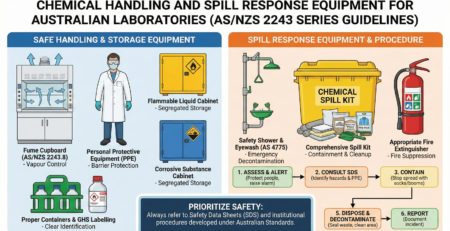
Chemical Handling and Spill Response Equipment for Australian Laboratories
Chemical hazards are one of the greatest risks in laboratories. Even a small spill can cause injuries, damage property, or compromise research...
read more 9 Sep
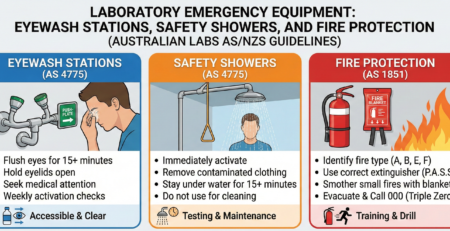
Laboratory Emergency Equipment: Eyewash Stations, Safety Showers, and Fire Protection in Australian Labs
Emergencies in the laboratory can happen without warning — from chemical splashes to fires. Preparedness is key, and having the right emergency...
read more 9 Sep
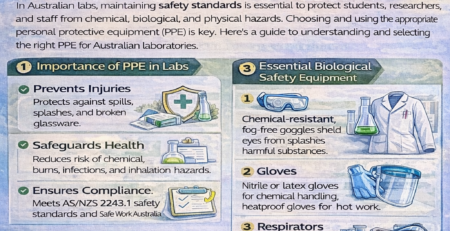
PPE in Australian Labs: Choosing the Right Protective Equipment with LabChoice
Personal Protective Equipment (PPE) forms the frontline defence in any laboratory. From handling corrosive chemicals to working with biohazards, the right PPE...
read more 9 Sep
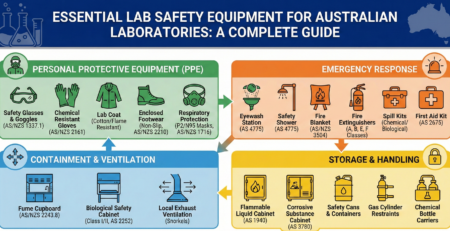
Essential Lab Safety Equipment for Australian Laboratories: A Complete Guide
Laboratories are environments of discovery and innovation, but they also present inherent risks. From chemical spills to biohazard exposure, ensuring safety is...
read more 29 Aug
Wire Gauze in the Laboratory: Why Every Lab Needs It for Safe Heating
Wire gauze is a simple but vital piece of laboratory equipment used to support glassware during heating. By diffusing heat evenly from...
read more