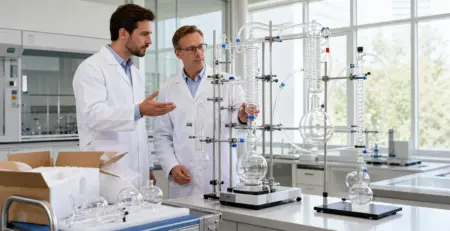
Build a Safer Glassware Specification Before Heat and Solvents
Petrochemical testing puts glassware under far more pressure than ordinary bench work. Heat, rapid cooling, volatile hydrocarbons and aggressive solvents can expose weak points in a vessel, seal or joint very quickly. At LabChoice Australia, we recommend writing a clear specification before selecting standard beakers, flasks and measuring cylinders.
Poorly matched glassware can crack during heating or cooling, introduce contamination, affect measurement accuracy and hold up a time-sensitive test. A thoughtful specification helps you protect your people, samples and results while making replacement purchasing simpler.
The right laboratory glassware for the petrochemical industry depends on the work in front of you. Routine quality control, distillation, viscosity testing, moisture analysis, sample preparation, extraction and research work can each need a different combination of glass type, shape and fittings. In October, we find it is also a sensible time for Australian laboratories to review equipment before summer conditions, shutdown periods and year-end purchasing activity.
Match Glass Chemistry to Process Temperatures
For work involving temperature changes, borosilicate glass is commonly specified because of its low thermal expansion and resistance to thermal shock. It is generally a stronger choice than standard soda-lime glass where regular heating, cooling or temperature variation is expected. This makes it well suited to controlled evaporation, reflux, distillation and digestion work.
Maximum temperature is only one part of the decision. We suggest looking at the full temperature profile of the process: how fast the vessel heats, how it cools, where it is moved and what it touches along the way. A vessel may be suitable for a given temperature but still be at risk if it is heated unevenly or cooled too quickly.
High-risk handling situations often include:
- Placing hot glassware onto a cold or wet surface
- Applying direct heat to one area of a vessel
- Moving heated equipment into a much cooler environment
- Rapidly cooling glass that has just been heated
- Using a vessel shape that does not suit the heat source
Vessel design matters as much as glass chemistry. Round-bottom flasks support more even heating, while condenser systems are useful for reflux and distillation setups. Heat-resistant beakers suit many preparation tasks, and thick-walled components may be more appropriate where vacuum or pressure-related conditions apply. We encourage you to match laboratory glassware for the petrochemical industry to both the temperature demands and the real handling conditions in your laboratory.
Glass itself performs well with many common petrochemical solvents, but a solvent path rarely includes glass alone. Caps, liners, stopcocks, tubing, labels, coatings and seals can all contact the sample or vapour. Before ordering, we recommend checking compatibility across the complete assembly, not only the vessel body.
Shape and closure design can make solvent work calmer and more controlled. Narrow-neck flasks may help reduce splashing during transfer or mixing. Amber glass can be useful where light exposure is a concern. Separating funnels support controlled liquid-liquid extraction, while reagent bottles with secure closures can assist with storage and transfer of fuels, oils, lubricants and chemical intermediates.
Capacity deserves the same level of attention. An oversized vessel can be awkward to handle, while too little headspace can create problems during shaking, heating or agitation. Adequate room for liquid movement and vapour management supports safer daily work.
For easier stock control, we often suggest standardising the most frequently used sizes across workstations. A considered set of common flasks, bottles, cylinders and beakers can help teams follow consistent methods and avoid needless delays when equipment needs replacing.
Specify Joints, Seals and Accessories as a System
A flask is only one part of a distillation, reflux, filtration or extraction setup. Ground-glass joints, adapters, condensers, receiving vessels and connectors need to work together cleanly. Standard joint sizes make this much easier, allowing components to be exchanged and replaced without rebuilding the whole setup.
Before placing an order, document the joint sizes already used in your laboratory. This small step can prevent an otherwise suitable item from arriving without a compatible partner. It also helps when you are replacing broken pieces in an established apparatus.
For volatile solvents and vapour-generating processes, the sealing arrangement needs careful thought. Properly fitted joints, joint clips, compatible grease where needed, PTFE stopcocks and chemically resistant seals can all influence how securely the system performs. Poor sealing may lead to solvent loss, unnecessary exposure, interrupted testing or unreliable results.
A purchase-ready system may include:
- Condensers, adapters and receiving flasks
- Funnels and vacuum connectors
- Joint clips, compatible seals and stopcocks
- Clamps, support stands and holders
- Cleaning accessories for routine maintenance
Ordering supporting items alongside core glassware helps ensure the apparatus can be assembled and used as intended when it arrives.
Verify Durability, Documentation and Supply Continuity
Technical suitability should sit alongside product information and long-term availability. We recommend choosing glassware with clear details on material type, capacity, dimensions, joint size and intended use. For volumetric items, it is also wise to check calibration requirements, tolerances and any relevant quality documentation needed for your method.
Durability affects day-to-day laboratory operations. Glassware that seems acceptable at first can become frustrating if it breaks often, performs inconsistently or needs frequent replacement. Durable borosilicate glassware can support a longer service life when it is handled, cleaned and stored correctly.
October is a practical review point for spring maintenance and year-end planning. Use the period to look at breakage patterns, replenish regularly used items and prepare for heavier workloads or summer shutdown schedules. Keeping common flasks, condensers, reagent bottles, measuring equipment and jointed components on hand can reduce disruption when an item is suddenly needed.
Turn Your Specification Into a Purchase-Ready Standard
A simple checklist makes glassware selection more consistent across your team. We recommend recording process temperature, heating method, solvent exposure, vessel type, required capacity, headspace, joint size, closure style, calibration needs and expected replacement frequency. Reviewing existing setups can also reveal mismatched joints, missing accessories and equipment that no longer suits the method.
When your specification reflects the actual process rather than appearance alone, purchasing becomes clearer and laboratory work becomes easier to manage. Select each item as part of the wider system, then keep your most-used formats consistent so replacements fit the way your team already works.
Source Glassware That Supports Reliable Lab Work
At LabChoice Australia, we help teams select laboratory glassware for the petrochemical industry suited to demanding thermal and solvent applications. Our range makes it easier to compare practical formats for routine testing, sample preparation and specialised workflows. If you need guidance on suitable options, contact us to discuss your requirements.