Organic chemistry labs depend on clean reactions, controlled heating, reliable seals, and repeatable workups. The right glassware does more than “hold liquid.” It improves yields, reduces solvent loss, prevents leaks, and cuts rework caused by contamination or poor temperature control. This buyer guide explains what to buy first, how to choose the right joint sizes and materials, and what matters most for Australian teaching labs, university research, and industrial QC.
What organic chemistry glassware must handle
Organic workflows typically involve:
- volatile and flammable solvents
- heating, reflux, and thermal cycling
- separations, drying, filtration, and solvent recovery
- moisture sensitivity for some reagents and intermediates
- vacuum steps, including rotary evaporation and vacuum filtration
Practical takeaway: your core set should prioritise borosilicate, standard joints, reliable seals, and stable clamping.
The essential organic chemistry glassware set
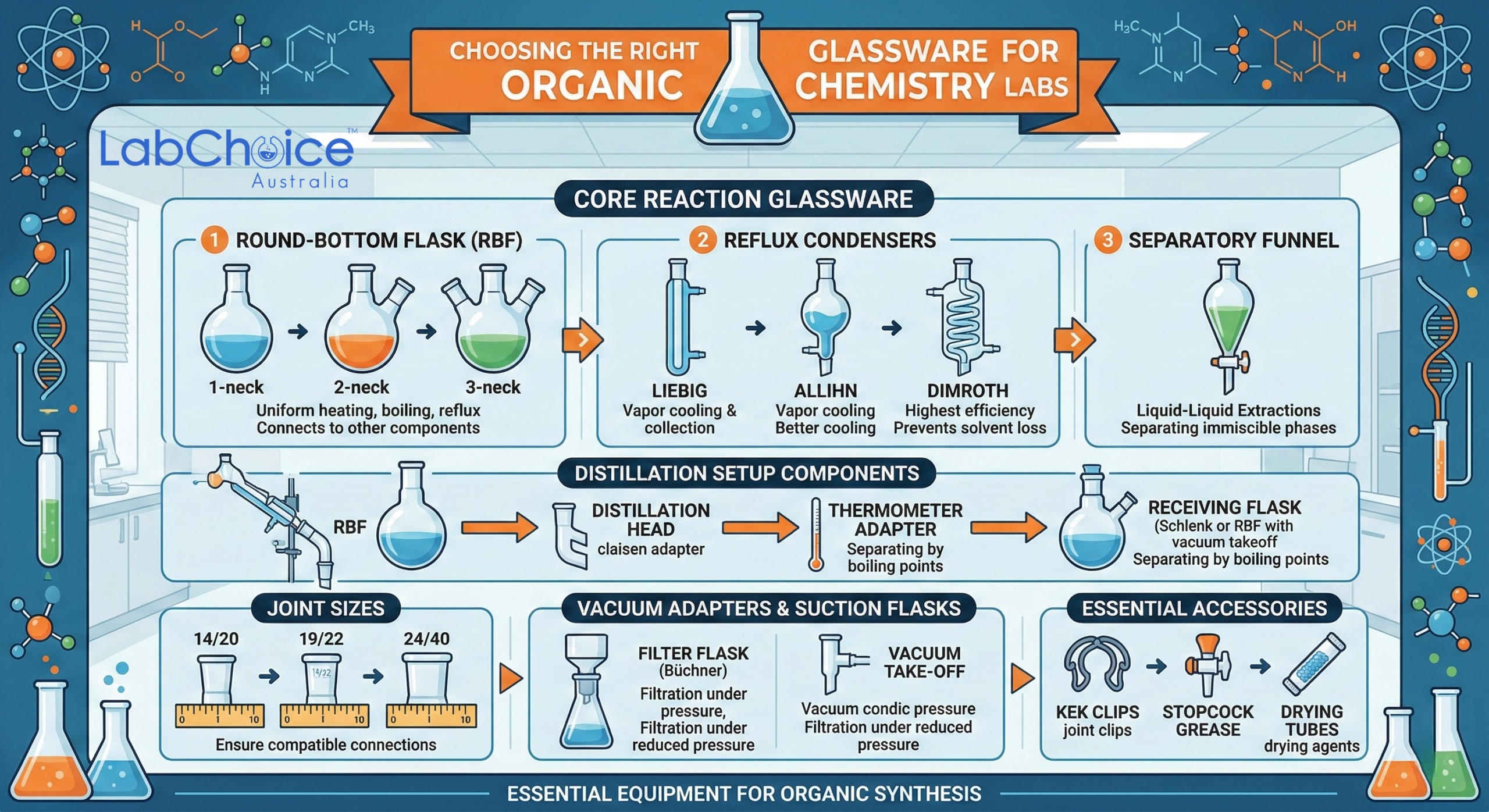
1) Round bottom flasks
Use cases:
- reflux, distillation, inert atmosphere reactions
- rotary evaporation transfers
- controlled boiling with mantles or oil baths
Buying criteria:
- borosilicate glass for thermal shock resistance and durability
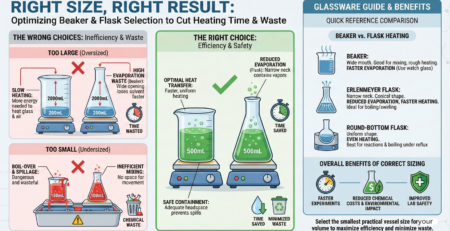
- correct flask size for your working volume, typically 2 to 3 times liquid volume for reflux
- jointed options where you connect to condensers or adapters
Use cases:
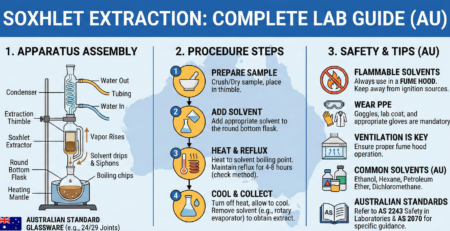
- reflux, distillation, solvent recovery
- controlling vapour loss, improving safety and yield
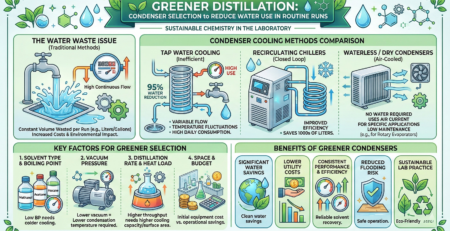
Choosing a condenser:
- Liebig for general-purpose reflux and distillation
- Allihn for higher surface area during vigorous reflux
- Graham or Dimroth where higher efficiency is required
Buying criteria:
- joint compatibility with your flasks and adapters
- appropriate length for your solvent range and heat load
- easy cleaning and robust hose connections
Use cases:
- liquid–liquid extractions, wash steps, phase separations
- standard organic workups, brine washes, solvent partitioning
Buying criteria:
- PTFE stopcock for solvent resistance and smooth control
- clear graduations and stable shape
- size matched to batch volume to reduce emulsions and spills
Use cases:
- removing drying agents, catalyst fines, precipitates
- vacuum filtration for faster separation
- consistent sample clarification
Common setups:
- filter flask plus Büchner funnel for routine vacuum filtration
- sintered glass funnels for reuse and consistent porosity selection
Buying criteria:
- flask volume with safe headspace
- funnel diameter matched to solids load
- vacuum compatibility, stable clamping
5) Reagent and solvent storage bottles
Use cases:
- storing solvents, prepared reagents, standards
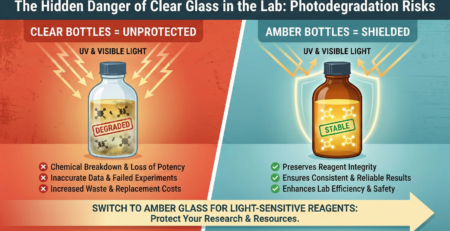
- controlling contamination and photodegradation
Buying criteria:
- borosilicate for durability and solvent resistance
- amber bottles for light-sensitive reagents
- reliable caps or stoppers, consider GL45 and PTFE-lined options where needed
6) Rotary evaporation glassware
Use cases:
- solvent removal, concentration, solvent swap
- recovering product after extraction and chromatography
Buying criteria:
- correct joint sizes for your rotavap model
- bump trap where appropriate for foaming or bump-prone mixtures
- borosilicate receiving flasks for repeated cycles
Joint sizes and compatibility: the buying decision that saves the most headaches
Organic chemistry rigs depend on standard taper joints. Standardising joint sizes across your lab reduces:
- leaks and poor seals
- broken components from forced fitting
- wasted time during setup changes
Buying criteria:
- choose a primary joint size for most assemblies
- ensure adapters match your most common connections
- keep spare clips, joint grease only where appropriate, and correct clamps
Glass type: borosilicate vs soda lime for organic labs
Organic labs frequently heat solvents and run reflux, distillation, and vacuum work. Borosilicate is generally preferred due to:
- better thermal shock resistance
- broader chemical durability in routine solvent work
- longer service life under repeated washing and heating cycles
If you want to reduce lifecycle cost and replacement frequency, borosilicate is typically the correct baseline for heated organic workflows.
Buying criteria checklist for organic chemistry labs
Chemical resistance and sealing
- PTFE stopcocks for separatory funnels
- PTFE-lined caps where solvent exposure is high
- consistent joint sealing, avoid mixing incompatible joint systems
Thermal performance
- borosilicate for heating, cooling, and repeated cycles
- correct mantle size for round bottom flasks
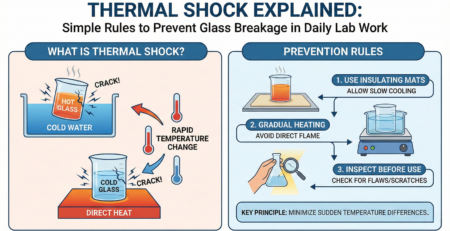
- avoid thermal shock handling, hot-to-cold bench contact is a common breakage source
Throughput and reproducibility
- standardise on a small set of flask sizes and joints
- keep filtration setups consistent, funnel size and media selection matters
- choose condensers that match your solvent load so you do not waste cooling water
Cleaning and contamination control
- dedicate glassware sets for sensitive work where needed
- avoid scratched or etched glassware for trace-sensitive applications
- dry storage using a desiccator for moisture-sensitive items
A practical “starter kit” map by organic workflow
Extraction and workup focused lab
Prioritise:
- separating funnels
- filter flask and Büchner funnel
- reagent bottles, including amber
- round bottom flasks and a condenser
Reflux and synthesis focused lab
Prioritise:
- round bottom flasks, condenser selection
- adapters, clips, clamps
- heating mantles and stable stands
Solvent removal and purification focused lab
Prioritise:
- rotavap glassware, receiving flasks, bump traps
- vacuum filtration components
- solvent storage bottles with secure caps
FAQs
What is the most important glassware to standardise first?
Joint sizes, round bottom flasks, and condenser compatibility. Standardisation reduces leaks and breakage and speeds up setup.
Do I need borosilicate for all organic chemistry work?
For heating, reflux, distillation, and repeated cycles, borosilicate is strongly recommended. For non-heated storage only, other glass types can be used, but organic labs typically benefit from borosilicate across the core set.
Which condenser should I choose for routine reflux?
A Liebig condenser is a strong general-purpose option. If your reflux load is higher or solvents are very volatile, an Allihn or higher efficiency design can improve stability at lower coolant flow.
Why do separatory funnels leak or seize?
Common causes are incompatible stopcock materials, lack of cleaning, residue build-up, or overtight handling. PTFE stopcocks are widely used because they resist many organic solvents and provide smoother control.
How do I reduce waste in organic workflows?
Use right-sized vessels to cut heating time, prevent solvent loss with proper condensers, standardise setups to reduce reruns, and use reusable filtration hardware where practical.
References
These are high-authority standards and guidance sources you can link on your website:
- ISO 3585, borosilicate glass 3.3, properties and specification
- ASTM E438, standard specification for glasses in laboratory apparatus
- ISO 4796, laboratory glassware, reagent bottles
- ISO 3819, laboratory glassware, beakers
- Safe Work Australia, managing risks of hazardous chemicals in the workplace (solvent handling, storage, and risk controls)
Organic chemistry runs smoother when glassware is consistent, durable, and matched to the real work, including reflux, extraction, filtration, and solvent recovery. LabChoice Australia supplies BORO 3.3 laboratory glassware, jointed components, condensers, filtration setups, and storage bottles suited to Australian labs. If you would like help choosing joint sizes, building a standard organic glassware set, or selecting the right condensers and accessories for your workflows, contact the LabChoice Australia team for practical guidance.