Outfitting a laboratory is not just a one-off purchase; it is a long-term commitment that shapes the quality, safety, and reliability of your work. Whether you run a secondary school science lab, a university teaching facility, or a research or industrial lab, the suppliers you choose will affect your results for years. The difference between a low-cost purchase and long-term value usually shows up later, through downtime, broken glassware, unreliable equipment, and frustrated staff.
This article walks through how to assess laboratory equipment suppliers for genuine long-term value. We look at warranty terms, calibration and compliance, after-sales support, and the quality of glassware and plasticware. As a premium online supplier of BORO 3.3 laboratory glassware, Polylab plasticware, and research-grade laboratory equipment for Australian laboratories and STEM classrooms, LabChoice Australia shares how experienced buyers think beyond the initial quote.
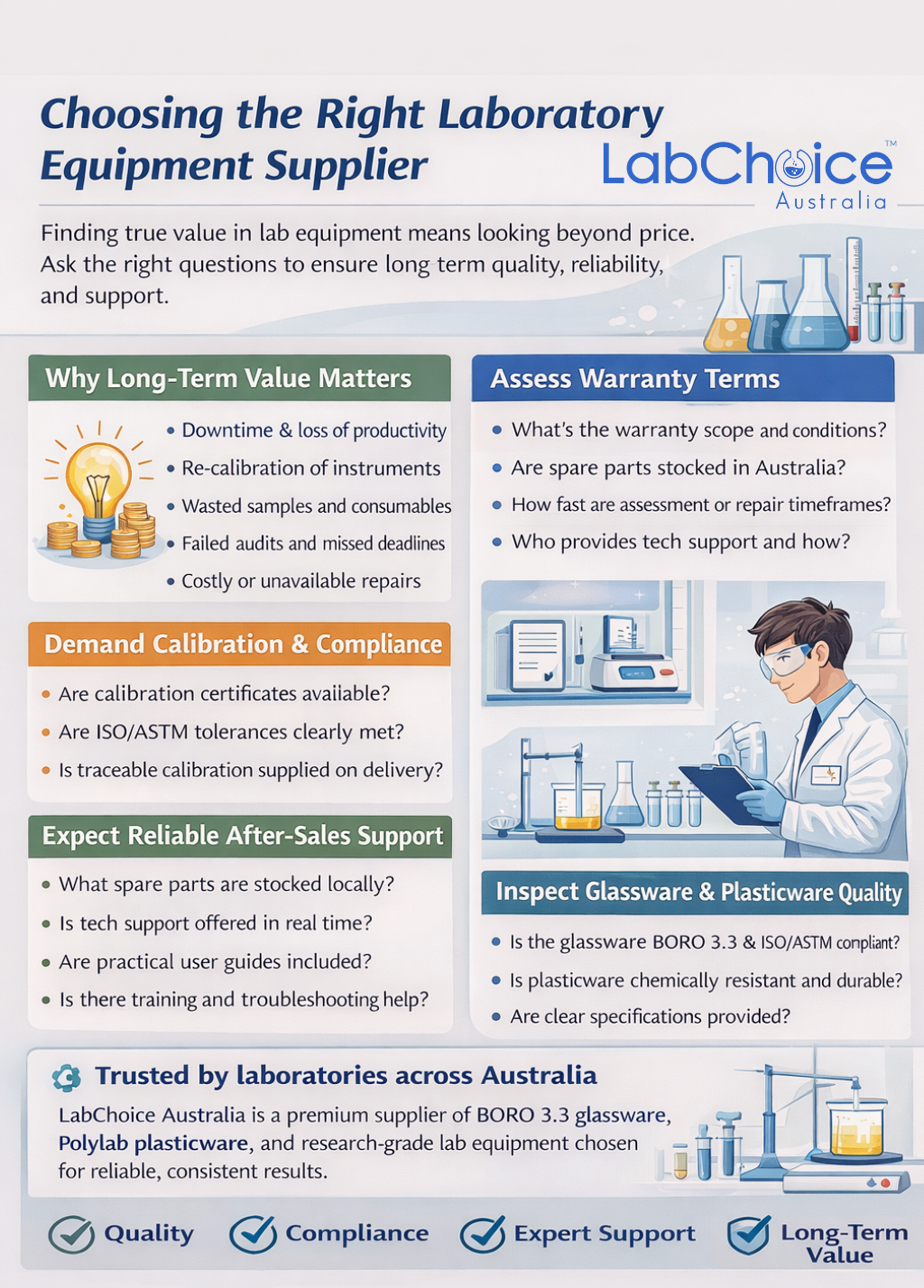
Why Long-Term Value Matters When Equipping Your Lab
Laboratory equipment is a capital investment that should deliver dependable performance for many years. When balances, incubators, shakers, hotplates, or distillation assemblies fail early, the cost is rarely limited to a replacement invoice.
The real cost of ownership often includes:
• Downtime while classes, experiments or production batches are put on hold
• Staff time spent troubleshooting, rearranging timetables or re-running work
• Re-calibration or validation checks after repairs
• Wasted reagents, samples and consumables from failed runs
• Damage to confidence in results, especially in accredited or audited settings
Not all laboratory equipment suppliers support that investment in the same way. Warranty conditions, access to spare parts, and clarity around calibration and service can differ widely.
At LabChoice Australia, we focus on research-grade value. Our BORO 3.3 glassware, Polylab plasticware, and carefully selected equipment are chosen to suit Australian teaching and research conditions, from busy chemistry labs and distillation suites to STEM classrooms that need durable, easy-to-use gear.
Understanding Warranty Terms Beyond the Brochure
A meaningful warranty is about more than a headline number of years. It should clearly state what is covered, under what conditions, and how support is actually provided in real laboratory environments.
For laboratory equipment, a useful warranty typically addresses:
• Parts and labour for faults in materials or workmanship
• Fair recognition of normal lab usage, including repeated heating or cleaning
• Clear processes for assessment, repair, or replacement
• Practical response times and realistic turnaround
Two suppliers may both quote a similar warranty period, yet differ in how they respond if an oven fails during peak assessment week or a shaker shows erratic performance just before an audit. You want to understand:
• Who coordinates repairs or returns
• Whether spare parts are readily available in Australia
• If there is support to diagnose simple issues remotely before shipping anything
For common items like ovens, incubators, shakers, balances, hotplates and distillation setups, strong warranty support is directly linked to the quality of your chemistry, biology and analytical outcomes. If an incubator drifts in temperature and support is slow, microbiology or cell culture work may be compromised. If a balance fault is not resolved quickly, routine testing, QC checks or teaching practicals can be thrown off schedule.
LabChoice Australia guides buyers through warranty terms in clear language before purchase, so you know how support will work in practice, not only on paper. Our focus is on reliable, research-grade equipment that can withstand demanding Australian school, university and industrial environments.
Calibration, Accuracy and Compliance for Real-World Work
Calibration is the process of checking and adjusting an instrument so that its readings are accurate and traceable to known standards. It is essential for balances, thermometers, pH metres, volumetric glassware, and temperature-controlled equipment such as ovens and incubators.
In many Australian laboratories, calibration connects directly to:
• ISO and ASTM methods and documented procedures
• Requirements under quality systems and technical standards
• NATA expectations for traceability and reproducibility
• Internal QA rules for research groups and industry labs
Poorly calibrated or uncalibrated instruments can:
• Reduce yield in synthetic or industrial processes
• Skew analytical results, making data unreliable
• Confuse students who are still learning good scientific practice
• Create safety risks when hot surfaces or chemical additions are misjudged
Before committing to any supplier, it is worth asking detailed questions about calibration options, such as:
• Is pre-delivery calibration available for balances, thermometers or pH metres?
• Can they supply traceable calibration certificates where needed, aligned with ISO or ASTM methods?
• What are the recommended re-calibration intervals for each instrument in typical Australian lab usage?
• Are there on-site service options, or is everything handled off-site?
At LabChoice Australia, we select instruments that are compatible with recognised standards and good laboratory practice. We help users understand how to maintain calibration over the life of the equipment, so accuracy does not quietly drift away between audits, semesters or production runs.
After-Sales Support That Keeps Your Lab Running
After-sales support is what happens once the cartons are opened and the equipment is in daily use. For a lab, this is where value either grows or disappears.
Useful after-sales support normally includes:
• Technical advice on correct set-up and operation
• Troubleshooting for error messages or inconsistent results
• Access to spare parts and consumables
• Clear documentation and user guides
• Practical training resources or usage tips for new equipment types
For Australian schools, TAFEs and universities, local knowledge matters. Teachers and technicians often need clear guidance when rolling out new STEM gear to large cohorts of students, many of whom are handling laboratory glassware, plasticware and heating equipment for the first time.
In chemistry, biology and analytical labs, common issues may include:
• Incorrect heating rates leading to broken glassware or poor distillation
• Incompatible plasticware leaching contaminants or deforming under heat
• Misaligned fittings in filtration or vacuum systems
• Misunderstood control settings on ovens or incubators
Laboratory equipment suppliers who understand BORO 3.3 glassware behaviour, Polylab plasticware compatibility, and correct operation of heating and distillation systems can resolve these issues quickly. LabChoice Australia’s technical team supports users from product selection through to post-installation questions, with the aim of keeping work safe, accurate and efficient across teaching, research and industrial testing.
Assessing Supplier Quality for Glassware and Plasticware
Glassware and plasticware might look similar at a glance, but small differences in material and manufacturing quality have big effects on performance and longevity.
BORO 3.3 borosilicate glassware is highly valued in labs because it offers:
• Strong thermal shock resistance for heating and cooling cycles
• Excellent chemical durability in contact with common reagents
• Stability for distillation, reflux and analytical procedures
For volumetric items, research-grade glassware quality influences:
• Accuracy of measured volumes
• Consistency between batches and over time
• Resistance to staining, etching or cracking in routine use
Where relevant, Australian laboratories also look for BORO 3.3 glassware that meets stated ISO or ASTM volumetric tolerances, particularly for analytical chemistry and quality control work.
When it comes to plasticware, buyers should consider:
• Resin quality and suitability for the intended chemical exposure
• Chemical resistance to acids, bases, solvents and biological media
• Repeatable moulding for consistent fit with caps, lids and accessories
• Compatibility with the cleaning or sterilisation procedures used in the lab
High-quality Polylab plasticware is designed to support everyday biology, microbiology and sample handling without warping, cracking or leaching unwanted substances that could interfere with results. This is particularly important in cell culture, environmental testing, food and beverage analysis, and student practicals where consistency and safety are critical.
Reliable laboratory equipment suppliers will always provide clear specifications, tolerances and usage recommendations. At LabChoice Australia, we give detailed information for our BORO 3.3 and Polylab ranges so you can match items to your teaching, research or testing protocols with confidence and in line with applicable ISO or ASTM methods.
Questions to Ask Before You Commit to a Supplier
Before choosing a long-term supplier, it helps to ask structured questions that reveal how they operate in practice. Consider covering:
• Warranty scope: exactly what is covered, for how long, and under what conditions?
• Calibration: are pre-delivery calibration and traceable certificates available where required?
• Spare parts: which parts are stocked in Australia, and what are typical lead times?
• Technical support: who will answer practical questions, and how quickly?
For glassware and plasticware, dig a little deeper:
• Do items conform to stated ISO or ASTM tolerances where relevant?
• Is there batch traceability or lot identification on packaging?
• Are BORO 3.3 items clearly labelled and matched to suitable heating tasks, including distillation and reflux?
• Is Polylab plasticware specified for the reagents and cleaning processes you use, including any autoclaving or disinfectant exposure?
You might also ask how the supplier supports specific use cases such as:
• High-temperature distillation or reflux in teaching or research labs
• Harsh chemical exposure in industrial or environmental testing
• High-turnover student laboratories where durability is essential
• Routine industry testing where consistency and repeatability are critical
• Biology and microbiology teaching, where clear labelling and robust plasticware reduce breakage and contamination risks
These questions help you distinguish between laboratory equipment suppliers focused on short-term sales and those committed to long-term partnerships, data integrity and safe, reliable performance.
Why Australian Buyers Trust LabChoice Australia
LabChoice Australia positions itself as a premium, research-grade supplier dedicated to Australian laboratories, schools and research teams. By focusing on BORO 3.3 glassware, Polylab plasticware and carefully selected laboratory equipment, we help buyers build labs that are accurate, durable and compliant with relevant standards.
Our approach combines:
• Expert guidance on product selection for chemistry, biology, STEM education, distillation, analytical work and industrial testing
• Clear specifications, calibration options and documentation to support ISO, ASTM and NATA-aligned workflows
• Practical, Australian-based after-sales support that keeps teaching schedules and research programmes on track
When you evaluate suppliers using the questions outlined above, you can see how LabChoice Australia’s focus on quality, reliability and technical support delivers genuine long-term value for Australian laboratories.
Equip Your Lab With Reliable, Expert-Supported Solutions
If you are comparing laboratory equipment suppliers, we can help you choose the right instruments for accurate, consistent results. At LabChoice Australia, we focus on quality, compliance and practical usability so your team can work with confidence. Talk to us about your workflow, standards and budget, and we will recommend options that fit. If you would like tailored advice or a quote, contact us today.