
8
Sep
Guide to Viral Assays in Australian Laboratories: Best Practices with LabChoice Australia
Viral assays are fundamental tools for detecting, quantifying, and studying viruses in clinical, research, and environmental laboratories across Australia. Whether for diagnostic testing, vaccine development, or viral research, choosing the right assay methods and equipment is critical to achieving accurate, reliable results.
At LabChoice Australia, we provide tailored guidance and advanced solutions to empower Australian labs in executing proficient viral assays that meet local regulatory standards and scientific goals.
What Are Viral Assays?
Viral assays encompass a range of laboratory techniques used to detect the presence and measure the amount of viruses in a sample. Assays can be qualitative or quantitative and may include molecular, immunological, or culture-based methods.
Common Types of Viral Assays
| Viral Assay Type | Description | Applications |
|---|---|---|
| Plaque Assay | Measures infectious virus particles by counting plaques formed on cell layers | Viral quantification and vaccine development |
| qPCR (Quantitative PCR) | Detects and quantifies viral genetic material using real-time PCR | Clinical diagnostics, research, viral load monitoring |
| ELISA (Enzyme-Linked Immunosorbent Assay) | Detects viral antigens or antibodies using enzyme-linked antibodies | Serological surveys, immune response studies |
| TCID50 (Median Tissue Culture Infectious Dose) | Determines virus infectious dose causing cytopathic effect in 50% of cultures | Viral infectivity assessment |
| Neutralization Assay | Measures the ability of antibodies to inhibit viral infection | Vaccine efficacy and immunology research |
Key Considerations for Viral Assays in Australian Labs
- Sensitivity and Specificity: Choose assays with high accuracy to minimize false positives/negatives.
- Sample Types and Preparation: Understand requirements for blood, saliva, swabs, or environmental samples.
- Regulatory Compliance: Ensure assays and reagents conform to Australian Therapeutic Goods Administration (TGA) and other standards.
- Throughput and Turnaround Time: Align assay choice with lab capacity and testing timelines.
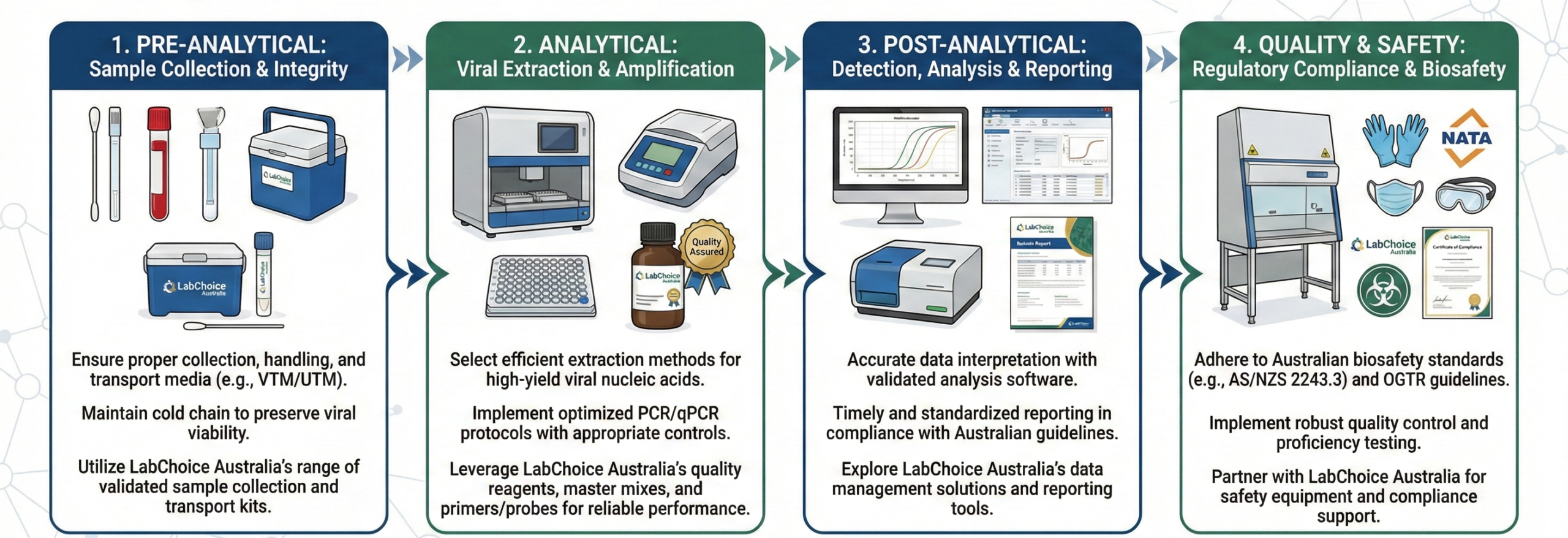
- Equipment Integration: Consider compatibility with LabChoice Australia’s PCR machines, flow cytometers, and ELISA readers.
Best Practices
- Employ validated protocols and regularly calibrate instruments.
- Ensure staff training on assay principles, execution, and biosafety.
- Implement robust quality controls including positive/negative controls in every run.
- Maintain stringent sample handling and contamination prevention practices.
FAQs: Viral Assays
Q1: What assay is best for rapid viral detection?
A: qPCR provides rapid, sensitive detection preferred in diagnostic settings.
Q2: Can viral assays quantify infectious virus particles?
A: Plaque assays and TCID50 measure infectious viral loads, unlike most molecular assays.
Q3: How do I ensure assay compliance in Australia?
A: Use TGA-approved reagents and follow Australian Standards for laboratory testing.
Q4: Is ELISA suitable for all viruses?
A: ELISA depends on available antibodies; it is widely used but not universal.
Author
Dr. Emily Harper, Ph.D., Biomedical Sciences — Specialist in virology and molecular diagnostics supporting Australian laboratories.
References
- Australian Government Department of Health. TGA Guidelines for Diagnostic Tests.
- Thermo Fisher Scientific. Overview of Viral Assays.
- University of Melbourne. Viral Assay Techniques for Clinical Labs, 2024.
- CDC. Principles of Viral Quantitation Methods.
